Building Blocks of the Peoples’ Digital Goods and Infrastructure (PDGI) Manifesto
Introduction
In the first PDGI workshop, we tried defining PDGI and differentiating it from other public interest technology narratives. We also explored PDGI’s relationship with the market, the state, communities, emerging technologies like AI and the planet. Building on this momentum, the second PDGI workshop aimed at drawing points of convergence on these ideas to chart out the building blocks of the PDGI manifesto.
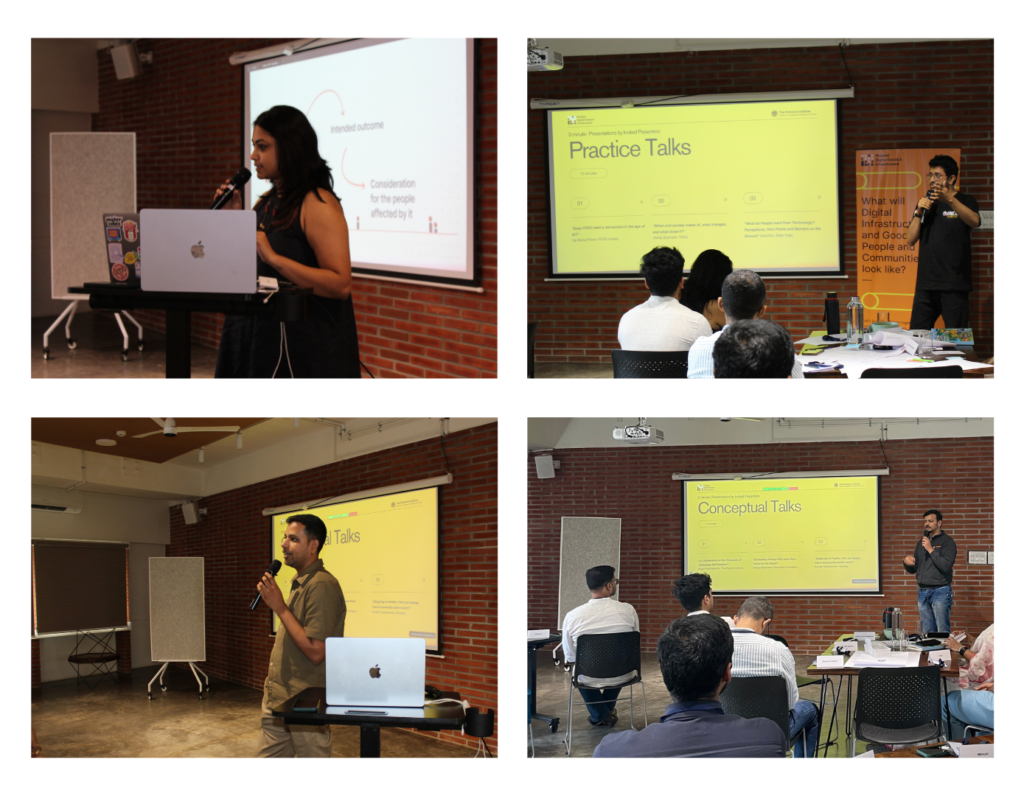
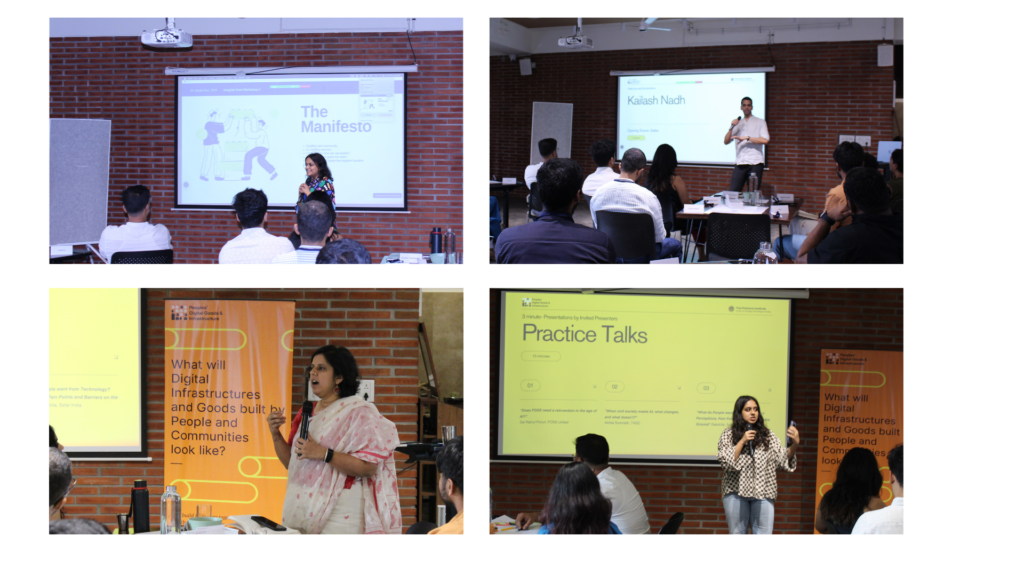
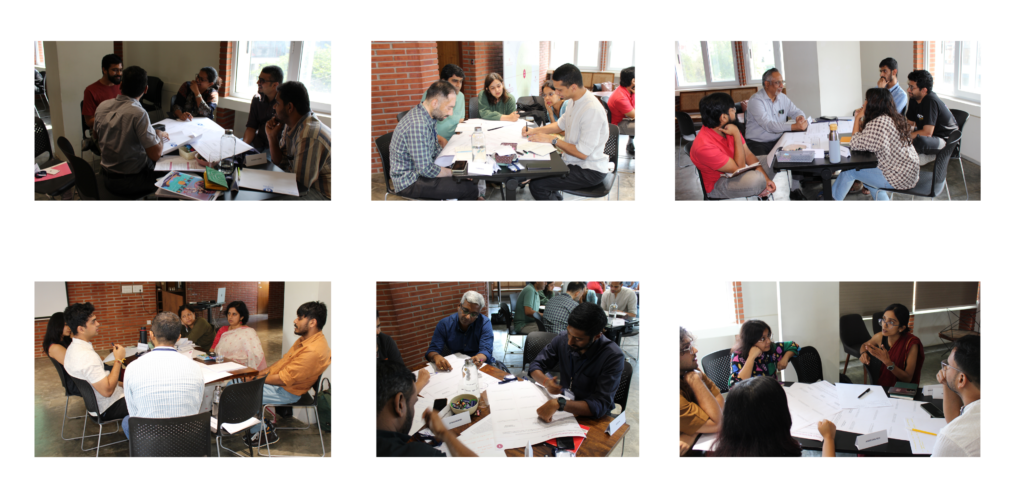
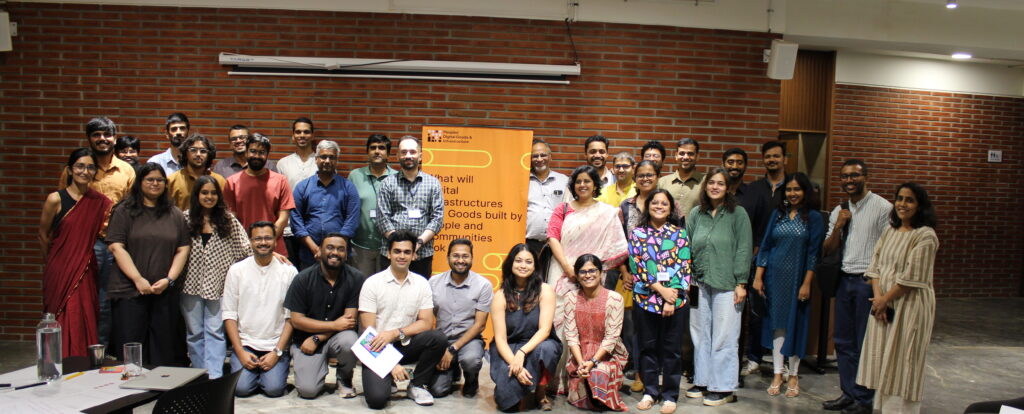
For this workshop, we invited participants representing different stakeholder groups. Participants worked in six groups across three paradigms of technology, community and governance. Each group explored technology, community and governance as the three pillars of PDGI, and then co-drafted propositions for a PDGI manifesto.
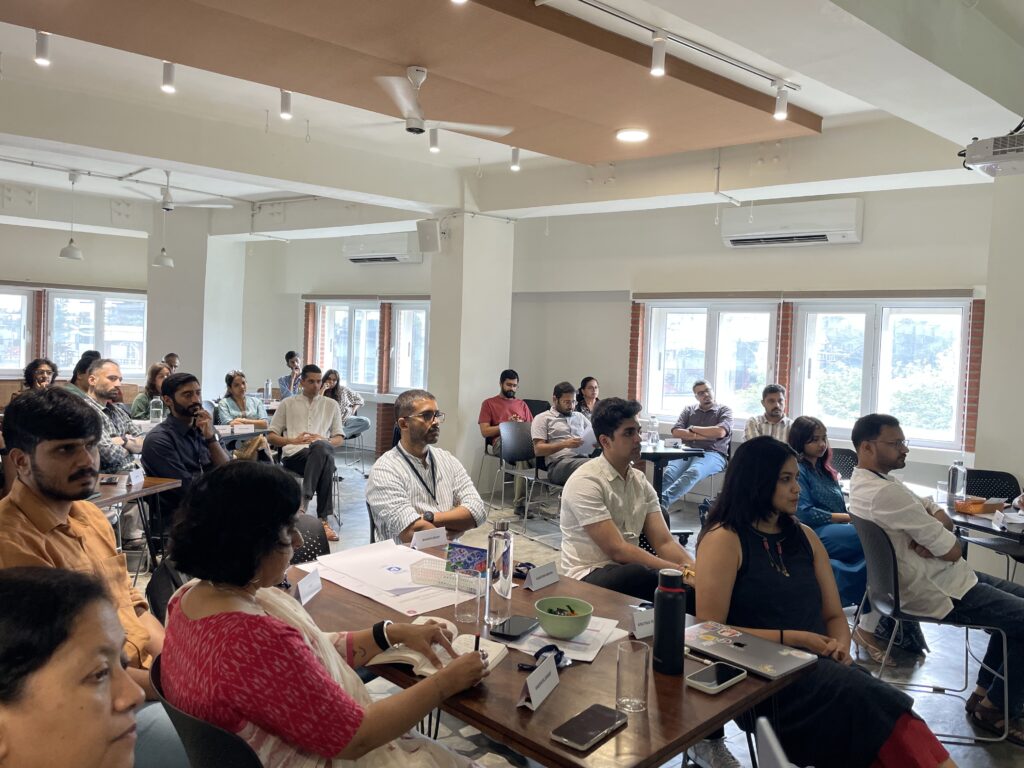
Through this piece, we share the propositions participants explored in the workshop. It draws on a semantic analysis of the participant group responses. The analysis shows strong convergence on the purpose of PDGI.
Process
We coded the responses of the six groups into core concepts, grouping synonyms together. For example, people first, people at the centre, user at the start and prioritising the human were coded as a single concept. For each concept, we counted how many of the six groups raised it. Because the unit of analysis is the group, the counts show how widely an idea was shared across groups. We then grouped the concepts into broader semantic clusters and for each domain, noted the emerging consensus, the tensions and the questions that remain unresolved.
Main Concepts Discussed
Table 1 ranks the sixteen core concepts that emerged from the group responses by the number of groups that raised them.
| Core concept | Terms and synonyms used across responses | Groups mentioning |
| People and human-centredness | people first, people at the centre, user, humanism, human wellbeing, dignity | 6/6 |
| Participation and collective decision-making | participation, collective decision-making, collectively building, co-creation, community voice | 6/6 |
| Interoperability and openness | interoperability, FOSS, open standards, exportable data | 5/6 |
| Community ownership and commons | community and collective ownership, digital community commons, community-based tech, cooperatives | 5/6 |
| Power redistribution | agency, power back to people, breaking and challenging control, countervailing forces, power balance, decentralisation | 5/6 |
| Inclusion and non-exclusion | inclusion, non-excludability, the margins and the marginalised, last person standing, accessibility | 5/6 |
| Rights, dignity and protection | natural rights, rights-based, do no harm, protection, autonomy | 4/6 |
| Transparency and accountability | transparency, traceability, feedback, grievance redress, disclosure, audits | 4/6 |
| Decentralisation | federated systems, distributed and collective power | 4/6 |
| Sustainability and planetary wellbeing | sustainability, planetary boundaries and degradation, a healthier planet | 4/6 |
| Plurality and diversity | multiplicity, non-homogeneity, diverse cultural and social identities, no singular knowledge | 3/6 |
| Data autonomy and governance | data minimisation, transparency, exportability and control | 3/6 |
| Trust | trust-building, trust-based governance | 2/6 |
| Financing and economic sustainability | funding, money, financing tools, financial participation, incentives | 2/6 |
| State and public institutions | government, lawmakers, elected representatives, bureaucrats | 3/6 |
| Technology as means, not end | not tech-driven, tech should help, tech in service of people and planet, enhance capacity | 3/6 |
Table 1
- Every group raised people and human-centredness, and participation and collective decision-making.
- Five groups raised interoperability and openness, community ownership, power redistribution and inclusion, and four raised rights, transparency, decentralisation and planetary wellbeing.
- Plurality, data governance and technology as a means rather than an end were each raised by half the groups, so they are better read as emerging.
- Some concepts remain contested or unresolved. Three groups raised the state in conflicting ways, recognising its scale and reach as well as its capacity to centralise power and exclude people. PDGI’s relationship with finance remains unresolved and participants described trust as something a system builds with practice rather than something it has from the start.
Semantic Analysis of Participant Responses
Grouped into broader themes, the concepts form seven semantic clusters (Table 2). Five of them reached very high convergence.
| Semantic Cluster | Participant Insights | Strength of Convergence |
| 1. Agency and human dignity | – People first, with the user at the start of the technology process and humanism as a guiding value – Three propositions: technology must respond to human purposes, people must retain control over consequential decisions, and dignity must not be traded for efficiency, data extraction or digital access – Dignity before data and digitality, so that no one loses access or is excluded for lack of identification – Rights, including natural rights, as the overarching structure of PDGI – People include users, indirectly affected communities, workers, future generations, the planet and non-human life – Agency lost to Big Tech to be reclaimed collectively | Very high |
| 2. Participation leading to ownership | – Communities participate in conception, design, testing, governance and ownership – Participation through problem identification, co-creation, feedback, voting, hosting code and data, and local governance – Participation means sharing decisions and ownership, not just giving feedback – Collective decision-making and community commons – Communities are heterogeneous, so representatives must be open to challenge or removal | Very high |
| 3. Openness and interoperability | – Interoperability, open standards, FOSS, open APIs and data portability – Openness as a default, lock-in and monopoly must be avoided – Interoperability often paired with decentralisation, so that local systems can work together – Standards set with communities, since interoperable systems can otherwise still exclude them – Possibly stronger openness obligations for GovTech, and interoperability extended to grievance and accountability processes | Very high |
| 4. Decentralised power | – Decentralised architecture, federated systems, cooperatives and DAOs – Local decision-making and community ownership – Separation of institutional powers, redundancy and resistance to monopoly – Countervailing forces that challenge concentrated power – Decentralised technology backed by redistributed power and local capacity | Very high |
| 5. Accountability and recourse | – Transparency, auditability and public disclosure – Grievance mechanisms, social audits and feedback loops – Clear liability for harm and access to human recourse – Communities able to challenge and amend the rules themselves | High |
| 6. Inclusion and plurality | – Inclusion as more than digital access, grounded in substantive equality – Design from the last person standing, not the average user – Low-literacy and oral interfaces, regional languages, disability access and offline options – An omnichannel approach that is multimodal and phygital – Recognition of different knowledge systems and of people without technical expertise | Very high |
| 7. Planetary responsibility | – Sustainability and respect for planetary boundaries – Attention to environmental impact and resource constraints in design – Technology in service of planetary wellbeing and for future generations | High, but less developed |
Table 2
Through this workshop, we could conclude that putting people first meant democratic control over how problems are framed. Groups asked that people must be treated as first-users rather than end-users and widened the circle of people to include future generations and non-human life.
While participation in mainstream mechanisms is looked at through the lens of seeking feedback, participants shared that it must be extended to include the ability of communities to define problems, share decisions and own what technology is built, with openness, decentralisation and accountability as the means to that end. Participants associated ownership to rights to contribute, disagree, fork, refuse or exit and mentioned data and platform cooperatives as models that enable this. On openness, participants highlighted that if communities cannot participate in setting standards, interoperable systems can still exclude them. Planetary responsibility was the least developed cluster and still needs indicators before it can be put into practice.
Consensus, tensions and unresolved questions
Table 3 mentions the emerging consensus, the tensions and unresolved questions that came up in the workshop.
| Domain | Emerging consensus | Tension and open question for the manifesto |
| Purpose | PDGI should put people, dignity and agency first. | Participants differ on whether PDGI is primarily about human welfare, the redistribution of power or planetary wellbeing. What, then, is its ultimate purpose? |
| Community | Communities should participate meaningfully in technology. | Communities are internally unequal and heterogeneous. Who counts as the community and who legitimately represents it? |
| Participation | Participation should extend into design and governance. | Participation can be slow, costly and difficult at scale. Which decisions must be participatory, and where is representation sufficient? |
| Ownership | Community and collective ownership is desirable. | No ownership model has yet been specified. What does community ownership mean legally, economically and technically? |
| Decentralisation | Concentrated technological power is undesirable. | Decentralisation can conflict with sustainability, efficiency and coordination. When should systems decentralise, federate or centralise? |
| Interoperability | Interoperability is a foundational principle. | When should interoperability be mandatory? |
| Openness | Free and open-source software, open standards and open access are strongly valued. | Absolute openness may conflict with privacy, security or context. What should be open, to whom, and under what conditions? |
| Data | Data minimisation, transparency and user autonomy matter. | The public utility of data can conflict with individual autonomy. When should data be public, private, cooperative or community-controlled? |
| State | The state has scale, reach and accountability functions. | The state can also centralise power and exclude people. What is its legitimate role in PDGI? |
| Markets | PDGI should resist extraction and profit-driven concentration. | Financing and sustainability remain unresolved. Can PDGI participate in markets without becoming extractive? |
| Technology | Technology should serve human and community goals rather than drive them. | How much standardisation is desirable remains unclear. What belongs in a universal PDGI standard, and what should be left to local context? |
| AI and agents | Human agency and accountability must persist in agentic systems. | The boundaries of human control need more deliberation. Which decisions must remain under human control as systems become agentic? |
| Inclusion | Design should begin from the margins and from excluded users. | Universal design may conflict with contextual specificity. How can PDGI design for plurality without creating fragmentation? |
| Governance | Checks and balances, transparency and recourse are essential. | No clear institutional model has emerged. |
| Planet | PDGI should account for environmental and intergenerational impacts. | Which planetary constraints are non-negotiable? |
Table 3
Participants agreed that communities should participate and that power should not be concentrated, but questions that participants spent more time discussing where on who represents a community and when systems should decentralise, federate or centralise.
We sought least convergence on questions concerning institutions and which institutional model could serve the PDGI paradigm appropriately. No institutional model has emerged with respect to governance of the PDGI ecosystem and technologies. The limits of human control over AI, financing and the role of the state are also some open questions.
Conclusion
PDGI is an overarching framework for understanding, building, and governing technology that enshrines people and peoples’ rights and liberties at its centre.
Participants from different stakeholder groups broadly agree on what that means in practice. Every group called for a peoples’ first understanding and participation with decision-making power. Most stakeholders also called for openness, community ownership, agency, decentralised systems and plurality. While the principles and values were highlighted time and again, we saw weaker agreement on how PDGI should run and be governed.
Five questions remain open:
- What governance system must PDGI entail?
- How do we define PDGI’s relationship with finance?
- What role should the state play?
- What does community ownership mean in law and in practice?
- Where must human control hold as AI becomes more autonomous?