Defining and Differentiating Peoples’ Digital Goods and Infrastructure
Insights from the first PDGI Workshop
Introduction
Digital infrastructure now mediates a large share of the relations between people, institutions and the state. Free and open-source software underpins much of it. Yet the infrastructure built on that foundation is often governed opaquely by a small number of public and private actors. Artificial Intelligence further deepens this asymmetry by removing human judgement from consequential decisions.
To try and answer some questions posed by these systems, Public Interest Technology (PIT) has taken up in the last decade, but most approaches only solve part of the problem. Digital Public Goods are defined as “open-source software, open standards, open data, open AI systems, and open content collections that adhere to privacy and other applicable laws and best practices, do no harm, and help attain the Sustainable Development Goals (SDGs)”. Digital Public Infrastructure is defined as shared, interoperable systems that deliver services at societal scale. Recent scholarship explores what is public about such infrastructure. It argues that competing narratives of publicness already embed a directionality, which should be made explicit and steered towards collectively defined outcomes. In India, researchers now call for a governance-first approach centered on rights and public oversight. The United Nations has issued a Universal DPI Safeguards Framework to mitigate individual and societal risks. Safeguards, in other words, are taking a post facto approach and are being fitted onto systems already in use.
These approaches then leave the question to be- who are these systems for and who decides how they are built? Peoples’ Digital Goods and Infrastructure (PDGI) seeks to take a technology lifecycle approach to answer this question.
PDGI proposes an overarching framework for understanding, building and governing technology with peoples’ rights and liberties at its centre. The term peoples places collective identity, rights and liberties at the core rather than treating each person as an isolated individual set against the system. PDGI imagines a framework of principles, standards, rights, obligations and practices that covers technology from conception and design to deployment and governance, and applies to everyone who makes or deploys it. Its first principle is that no critical digital service on which a person’s life and wellbeing depend should exist without easily accessible non-digital alternatives.
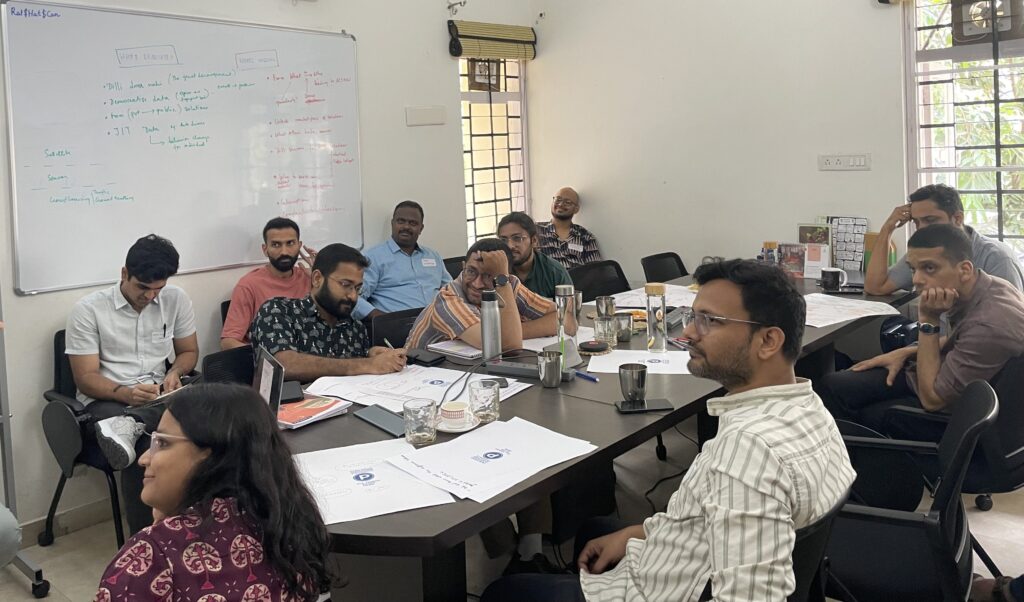
Through this piece, we try to dig deeper into some of these nuances by exploring how different stakeholders approached this proposition through the first PDGI workshop. Through this workshop we explored what should and should not underpin PDGI, how PDGI distinguishes itself from adjacent paradigms and should PDGI be positioned in relation to the state, the market, communities and emerging technologies.
What is PDGI? Or better, what can it be?
Across groups, PDGI was defined less by a type of technology than by whom it serves and how.
Peoples were defined collectively through the lens of communities, collectives, associations, cooperatives and trade unions. Participants described a system built and designed by the people, bottom up and accountable to people.
Building on similar lines, in data governance, research argues that data is valuable and harmful because it puts people into relations with one another at the population level, so individual data rights cannot address its harms and data governance has to become collective and democratic.
Digital was defined as a means of enabling and facilitating participation and as means of enabling access, bound by interoperability, open standards and implementation that is non-prescriptive.
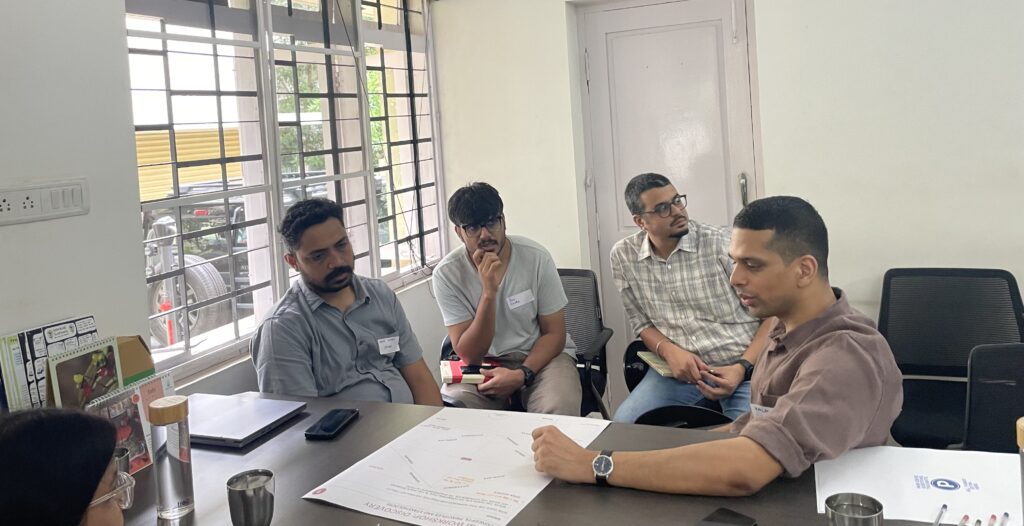
Goods included services, welfare, information, justice, knowledge, standards, values and an operational protocol for people. In this sense, by counting standards and protocols as goods, participants placed the rules of governance among the things PDGI produces. This finding can be looked at through the lens of Ostrom’s research against the “tragedy of the commons”, where the author argued that communities can manage shared resources well over long periods through rules they make and enforce themselves, without needing either state control or privatisation.
Infrastructures included platforms, datasets, open data, spaces, persons, dialogue spaces and commons. In this section, participants also categorized fallbacks and exit strategy as infrastructure. Interestingly, research argues that infrastructure becomes visible upon breakdown which is precisely why we must direct our attention toward repair, maintenance, reuse, recovery, and the labor that keeps technological systems functioning. Repair also makes forms of situated knowledge visible that conventional innovation narratives often overlook. This approach is important to sustain resilient infrastructures.
In the next part of the workshop, stakeholders tried to work around the understanding of what may distinguish PDGI from other public interest technologies (PITs).
PDGI and Neighbouring Paradigms
In this segment, participants drew many common and differentiating lines between the neighbouring paradigms of Free and Open Source Software, Civic Technologies, Digital Public Goods, Digital Public Infrastructures and Government Technologies.
| Compared to | Where PDGI overlaps | Where PDGI differs |
| FOSS | Both are participatory and built through co-creation. Both value the commons, decentralisation, diversity and adaptability. Both are rooted in rights and freedoms, favour collective ownership and keep intellectual property public and transparent. Both rely on contributions from a community, and value accountability, grievance redressal and civic audit. | In practice, many open source projects are centralised and run top-down, even though taking part is voluntary. Big Tech takes a strong interest in them. FOSS includes code, not people. There exists a skill gap so access is not guaranteed for everyone, and users are not always given a clear way to leave a system. |
| GovTech | GovTech is built for the public, though often not for the people who actually use it. It is driven by policy, delivers services and supports regulators, and can bring radical transparency when done well. It aims at the public good, data ownership and solving real problems. With the right incentives, it can put people at the centre. | GovTech is mostly top-down, centralised, opaque and inflexible. Rules on intellectual property are unclear, procurement is complex and systems are not standardised. It is driven by needs and policy rather than rights. It carries power imbalances and the risk of state-run monopolies. |
| DPI and DPGs | DPI and Digital Public Goods are meant to be public goods that everyone can access and use. They work as public utilities, aim at social good and are run as long-term programmes. | They are often centralised and opaque, with restricted intellectual property. They are paid for with public money but shaped by markets and bureaucracy. They are imposed by the state, focus on financial transactions and can create monopoly power. They offer one model for all, are often mandatory and can exclude people. |
| Civic and public-interest tech | Civic tech is participatory, built through co-creation and often led by committed individuals. It is rights-based and funded by collectives, civil society and philanthropy. It responds to grassroots needs and values accessibility, privacy, social good and users. | Projects tend to be short-term and isolated from one another. They often depend heavily on the government and large companies show little interest. They are not always open source, interoperable or standardised. They rely on individual champions rather than lasting systems, do not require people to take part in design and lack a rights-based mandate. |
In the next part of this workshop, we tried to explore where PDGI is located vis a vis – the state, markets, communities, places and cultures, individuals and other emerging technology systems including Artificial Intelligence.
What is PDGI in relation to….
The larger understanding between stakeholders in this aspect was that PDGI is not a replacement. More than anything, it aims to serve the role of an enabler and a corrector.
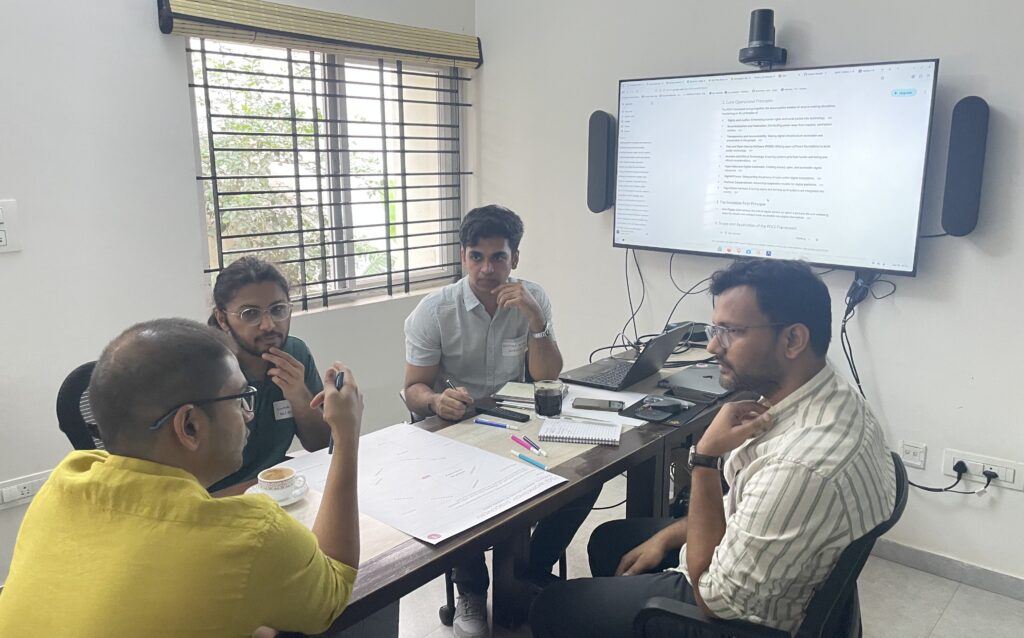
In this segment, participants suggested that the state and the market must create the conditions for PDGI through rules, procurement and fairer competition. Decisions about what PDGI should do must be with communities and individuals. On the other hand, AI and other emerging technologies are tools that must stay under human control. This makes PDGI as much a question of governance as of technology.
Conclusion
The first PDGI workshop aimed at testing the thesis the PDGI coalition came up with for the paradigm. The workshop saw convergence around the same and helped us chart the next steps for the paradigm.
Participants increasingly looked at PDGI through the lens of whom it serves and how it interacts with peoples and rights. The next steps the workshop guided us for is charting out the value ecosystem of PDGI and principles that must underpin the PDGI manifesto.
We look forward to sharing more on these next steps in the upcoming pieces.